Page 3 of the book, in Pranayama
Cyclic Sighing vs Box Breathing vs 4-7-8: Which Calms You Fastest?
A Stanford trial compared breathing techniques head to head. Cyclic sighing came out ahead for mood. Here is how each method works, what the evidence says, and which to use when.
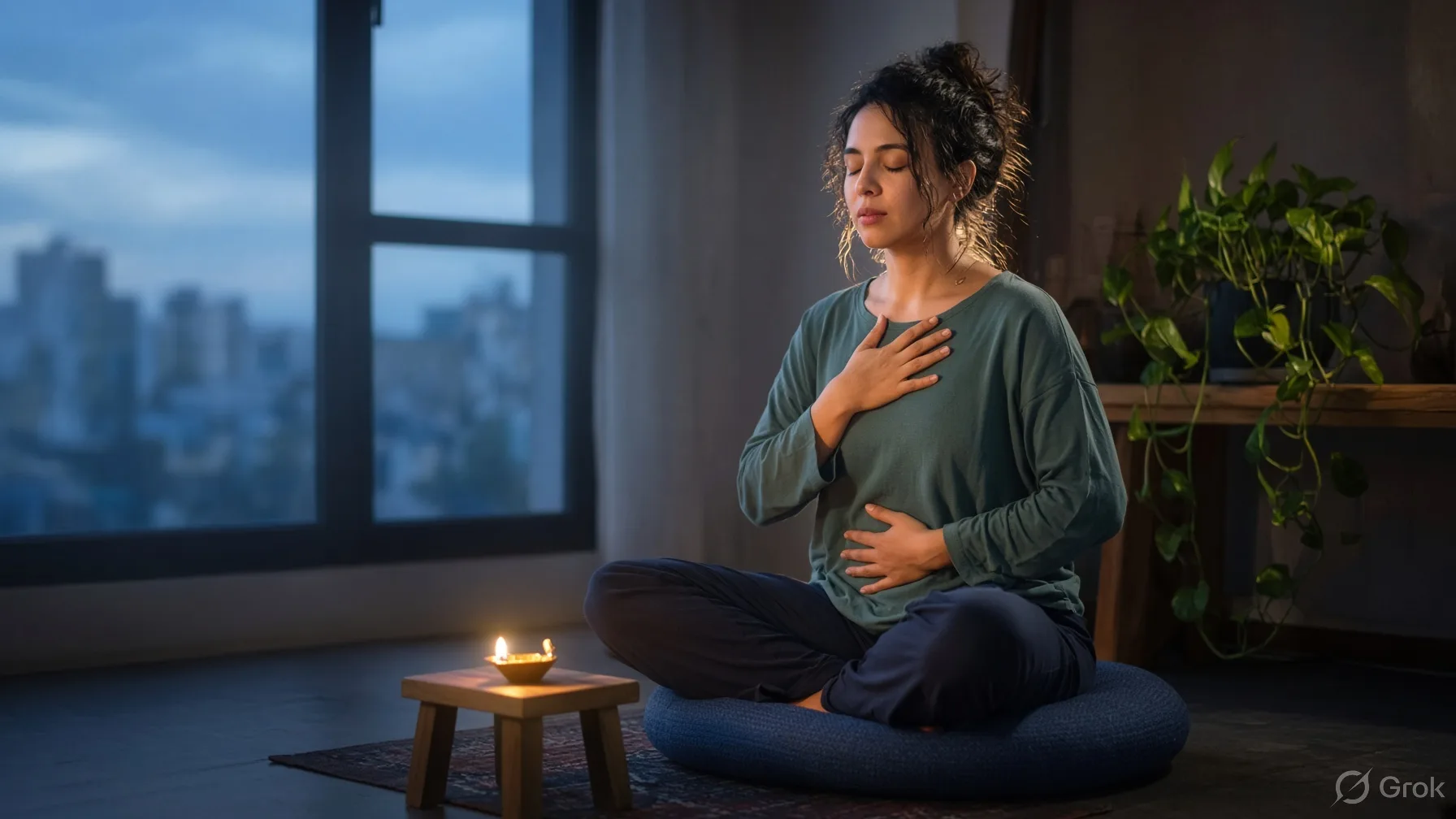
If you want one breathing exercise for everyday stress, start with cyclic sighing: two inhales through the nose, then one long, slow exhale through the mouth, repeated for five minutes. In the best head-to-head trial so far, it lifted mood more than box breathing or mindfulness meditation. Box breathing is a good second choice when you need focus, and 4-7-8 is worth trying at bedtime, though its evidence is thinner.
All three are free, take minutes, and can be done anywhere. The differences between them are real but small, so the best one is partly the one you'll remember to use.
The three methods side by side
| Cyclic sighing | Box breathing | 4-7-8 | |
|---|---|---|---|
| Pattern | Double inhale, long exhale | Inhale 4, hold 4, exhale 4, hold 4 | Inhale 4, hold 7, exhale 8 |
| What it emphasizes | The exhale | Even rhythm and control | Breath holding and a slow exhale |
| Tested head to head? | Yes, in a randomized trial | Yes, in the same trial | Not in that trial |
| Best for | Stress and low mood during the day | Focus under pressure | Winding down at bedtime |
| Breath holds? | None | Short | Long |
| Time needed | 1–5 minutes | 2–5 minutes | 4 rounds, about 1 minute |
What the Stanford trial found
In a study published in Cell Reports Medicine in 2023, researchers at Stanford randomly assigned 111 healthy adults to one of four five-minute daily practices for a month: cyclic sighing, box breathing, cyclic hyperventilation (a fast, energizing pattern), or mindfulness meditation.
The breathing groups improved their daily mood more than the meditation group. Cyclic sighing stood out, producing the largest gain in positive mood and the biggest drop in resting breathing rate over the month.
Two important limits. First, people with moderate to severe psychiatric conditions were not included, so the results apply to everyday stress, not anxiety disorders. Second, one trial is one trial. A smaller student poster from the University of Waterloo in 2024, which has not been peer reviewed, found measurable effects on breathing and heart rate variability but no improvement in mood. Treat cyclic sighing as promising, not proven.
How to do cyclic sighing
- Sit or stand comfortably and let your shoulders drop.
- Breathe in through your nose until your lungs feel mostly full.
- Without breathing out, take a second, shorter sip of air through the nose to top up.
- Breathe out slowly through your mouth, as long as is comfortable, until your lungs feel empty.
- Repeat for one to five minutes. The exhale should be clearly longer than the two inhales combined.
Even a single cycle can help take the edge off a tense moment. Five minutes a day is what the trial used.
How to do box breathing
- Breathe out fully.
- Breathe in through the nose for a count of four.
- Hold gently for four. Keep the throat relaxed, not locked.
- Breathe out through the nose or mouth for four.
- Hold empty for four, then begin again.
If holds feel uncomfortable, shorten them to two counts or drop them entirely. Box breathing's strength is its steady rhythm, which gives an anxious mind something to follow.
How to do 4-7-8
- Rest the tip of your tongue on the ridge behind your upper front teeth.
- Breathe out completely through your mouth with a soft whoosh.
- Close your mouth and breathe in through your nose for four counts.
- Hold for seven counts.
- Breathe out through your mouth for eight counts.
- Repeat for four rounds, no more at first.
The long hold is what makes 4-7-8 feel intense to some people. Count quickly at first if you need to. The ratio matters more than the seconds.
Which one to use, and when
| Situation | Try | Why |
|---|---|---|
| A stressful moment at work | 2–3 cyclic sighs | Fast, quiet, no counting |
| Before a presentation or exam | Box breathing, 2 minutes | Rhythm helps focus |
| Lying awake at night | 4-7-8, 4 rounds, then normal breathing | Slows you down without much effort |
| A daily habit for mood | Cyclic sighing, 5 minutes | The method with the best trial evidence |
If you're building a gentle movement practice alongside this, one round of cyclic sighing before the final rest in our 30-day home yoga plan works well. For bedtime, the yoga nidra practice for sleep goes further than any breath alone.
Why a longer exhale calms you
Your heart naturally speeds up a little when you breathe in and slows down when you breathe out. This rhythm is normal and healthy. Breathing patterns that make the out-breath longer than the in-breath lean on that slowing phase, which is one reason techniques like cyclic sighing and 4-7-8 feel calming. Slower breathing overall also tends to ease the tense, shallow chest breathing that often comes with stress.
What breathing can't do is fix the cause of ongoing anxiety. Think of it as a fast way to turn the volume down in the moment, so you can think more clearly about what to do next.
Common mistakes
- Breathing too big and too fast. Deep, rapid breaths can make you dizzy and tingly, which feels like more anxiety. Keep the in-breath gentle and let the out-breath do the work.
- Forcing long holds. If a hold makes you panicky, shorten it or skip it. The long exhale matters more than the hold.
- Only practicing in a crisis. A technique you've practiced when calm is much easier to use when you're upset.
- Watching your heartbeat. For some people, focusing inward makes anxiety worse. Try counting on your fingers, or looking at something in the room while you breathe.
Questions people ask
What's the difference between a physiological sigh and cyclic sighing?
A physiological sigh is a single double inhale followed by a long exhale, something the body also does on its own. Cyclic sighing is doing that pattern on purpose, over and over, for a few minutes. The Stanford trial tested five minutes of cyclic sighing a day.
How quickly does it work?
Many people feel a little calmer within a minute or two. The trial measured the benefit of practicing daily for a month, so regular practice appears to matter more than any single session.
Can breathing stop a panic attack?
It can make a panic attack easier to ride out and may shorten it for some people, but it isn't a treatment for panic disorder on its own. Our printable panic attack breathing card is designed for that moment, and recurring panic attacks are worth discussing with a doctor or therapist.
Should I breathe through my nose or mouth?
For cyclic sighing, breathe in through the nose and out through the mouth. For box breathing, either works. Use whatever feels comfortable if your nose is blocked.
Is it safe during pregnancy?
Gentle breathing with long exhales is generally fine. Skip long breath holds and any fast, forceful breathing, and check with your provider if you have questions.
The short version
Cyclic sighing has the strongest early evidence and is the easiest to do anywhere. Box breathing suits moments that need focus. 4-7-8 is a reasonable bedtime ritual. Whichever you pick, practice when you're calm, so it's familiar when you're not.
Sources
- Balban MY et al. Brief structured respiration practices enhance mood and reduce physiological arousal. Cell Reports Medicine, 2023 — randomized trial, 111 participants
- Stanford Medicine: Cyclic sighing can help breathe away anxiety — plain-language summary of the trial
- Boucher et al. Psychology Discovery Conference poster, University of Waterloo, 2024 — unpublished student poster; not peer reviewed