Page 5 of the book, in Sadhana
Yoga for Beginners at Home: Your First 30 Days
Fifteen minutes, four days a week, six poses repeated until they feel familiar. A calm, week-by-week plan for starting yoga at home, with easier options and clear stop signs.

Start with fifteen minutes, four days a week, on a clear patch of floor, and repeat the same short set of poses until they feel familiar. That is the whole plan for your first month. Variety can wait. Consistency can't.
You'd be starting in good company. In 2022, 16.9% of US adults said they had done yoga in the past year, according to the CDC's National Health Interview Survey. Women (23.3%) were more than twice as likely as men (10.3%) to practice, and use dropped with age: 21.3% of adults aged 18 to 44, 14.1% at 45 to 64, and 8% at 65 and older. Close to three in ten people who practiced said they did it at least partly to manage pain.
Home practice has one real weakness: nobody is watching your knees. So this plan sticks to slow, simple shapes, gives an easier version of every pose, and tells you plainly when to stop.
What you need, and what you can skip
You need less than the shops suggest. A floor with room to lie down with your arms overhead is the only real requirement.
- A non-slip surface. A basic mat is ideal. On carpet, a folded blanket works for the first week.
- Two firm cushions or a rolled towel. These do the job of blocks and bolsters until you know you'll keep going.
- A wall. It is the best balance aid in the house, and it's free.
- Loose clothes and bare feet. Socks slide.
You can skip straps, special leggings, apps and anything heated. If you want to set up a proper corner later, our guide to building a home yoga space in any size room walks through it.
The six poses you'll repeat all month
These six cover the basic movements of the spine and hips: bending forward, arching back, lengthening, lunging and resting. Hold each for five slow breaths unless the plan says otherwise.
- Mountain pose (Tadasana). Stand with feet hip-width apart, weight spread across the whole foot, arms long by your sides. Let the crown of your head float up. Easier: stand with your back against a wall.
- Cat-cow. On hands and knees, breathe in as the belly drops and the chest lifts, breathe out as the back rounds like a cat. Move with the breath, not faster. Easier: do it seated in a chair with hands on your knees.
- Child's pose. From hands and knees, sit your hips back toward your heels and rest your forehead down. Easier: widen the knees and put a cushion under your chest or forehead.
- Downward-facing dog, knees bent. From hands and knees, tuck your toes and lift your hips up and back into an upside-down V. Keep the knees generously bent so your back stays long. Easier: do it with hands on a wall or a kitchen counter.
- Low lunge. Step one foot between your hands, lower the back knee to the floor on a folded towel, and bring your hands to the front thigh. Easier: keep your hands on two cushions or a chair seat.
- Bridge. Lie on your back, knees bent, feet flat. Press through your feet and lift your hips a few inches, then lower slowly. Easier: lift only halfway and repeat three times instead of holding.
Every session ends with two to three minutes lying on your back in Savasana, the resting pose. Skipping it is the most common beginner mistake. It is where your breathing settles and the session actually lands.
The 30-day plan, week by week
The plan adds time slowly and adds only one new element each week. If a week feels hard, repeat it. There is no prize for finishing on day 30.
| Week | Days | Minutes | Focus | New this week |
|---|---|---|---|---|
| 1 | 4 | 10–12 | Learn the shapes | The six poses, 3 breaths each |
| 2 | 4 | 15 | Link breath to movement | 5 breaths per pose, cat-cow with breath |
| 3 | 4–5 | 15–20 | Build steadiness | Hold down dog and bridge a little longer |
| 4 | 5 | 20 | Flow gently | A slow half sun salutation to warm up |
In week four, the warm-up is a slowed-down version of the sequence in our step-by-step guide to sun salutation, with easier options. Learn it there rather than from a fast video.
A sample 15-minute session
This is what a week-two day looks like. Set a gentle timer and don't rush the transitions.
| Time | What you do |
|---|---|
| 0:00–1:30 | Sit or lie down, breathe slowly through the nose, notice how you feel today |
| 1:30–3:30 | Cat-cow, 8 slow rounds |
| 3:30–5:00 | Child's pose |
| 5:00–7:00 | Downward dog with bent knees, twice, resting in child's pose between |
| 7:00–9:30 | Low lunge, each side |
| 9:30–11:00 | Mountain pose, then walk back to the floor |
| 11:00–12:30 | Bridge, three lifts |
| 12:30–15:00 | Savasana |
How to tell it's working
Don't judge the first month by flexibility. The earlier signs are quieter, and they're the ones that predict whether you'll keep going.
- You reach for the mat without negotiating with yourself.
- Getting up off the floor feels a little easier.
- Your breathing slows down sooner in each session.
- You notice tension in your shoulders or jaw during the day and let it go.
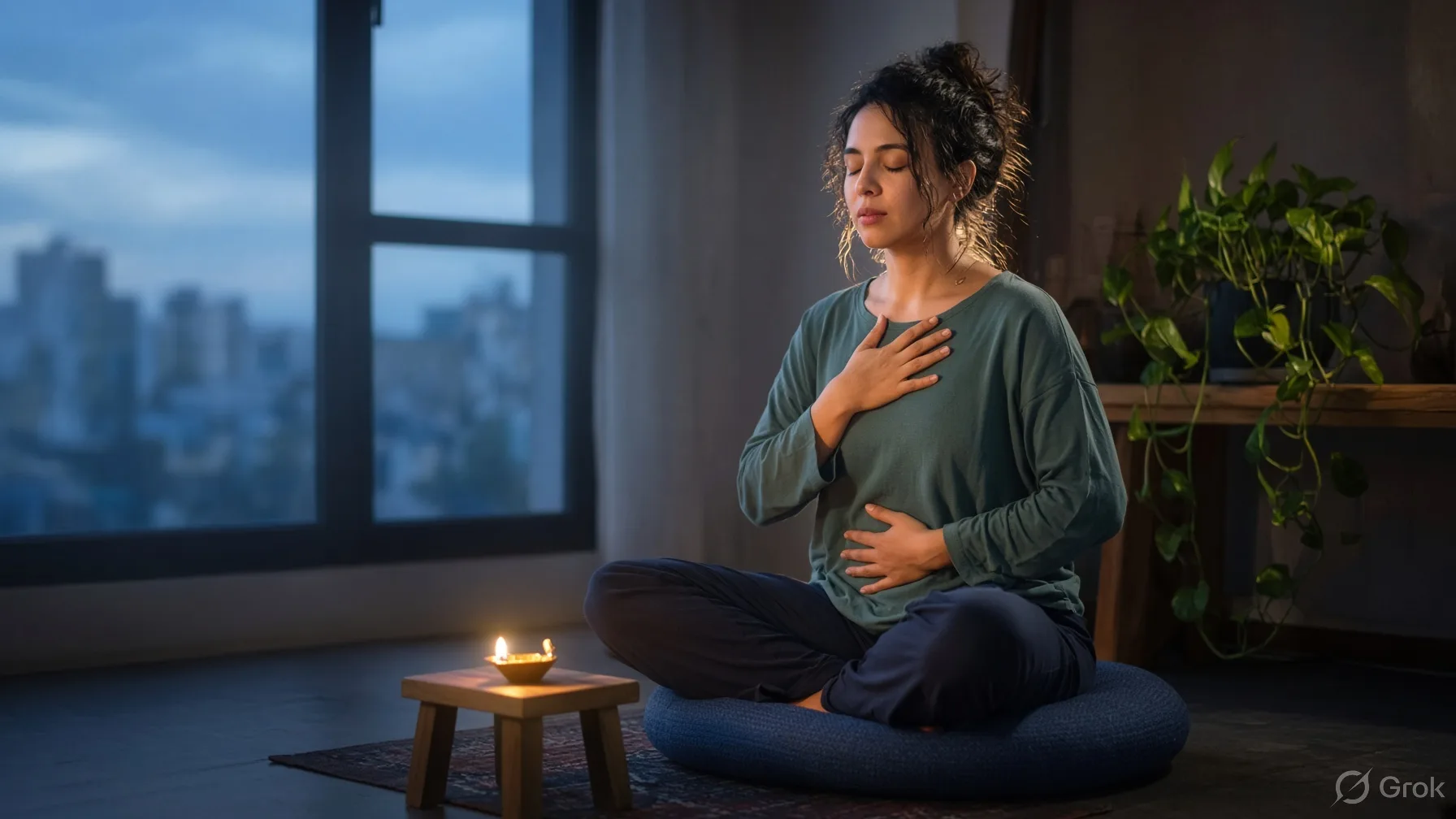
If you'd like the breathing side to develop too, a few minutes of slow, exhale-focused breathing before Savasana pairs well with this plan.
When to stop, and when to check with a doctor first
Yoga is generally low risk, but it isn't no risk. In the large Cochrane review of yoga for back pain, the most common side effect was simply more back pain, usually mild. Pain is information. Listen to it.
Beginner questions
What's the best time of day to practice?
The time you can repeat. Mornings help some people feel energized; evenings help others unwind. Consistency matters much more than the clock.
Should I eat before yoga?
Leave about two hours after a large meal, or an hour after a light snack. Practicing on a very full stomach is uncomfortable, especially in forward bends and twists.
Is it normal to feel sore?
Mild muscle soreness a day or two after a new practice is normal, especially in the legs and shoulders. Joint pain or sharp pain is not; ease off and use the easier options.
Can I use videos instead?
Yes, but choose slow beginner videos and pause often. Many videos move faster than a true beginner should. This plan works well alongside one or two gentle videos a week.
Will yoga help me lose weight?
Gentle yoga burns fewer calories than brisk walking, so it isn't a fast route to weight loss. It can support healthier habits, better sleep and less stress, which all help over time.
After day 30
By now the six poses should feel like home. The next step is choosing a direction instead of adding random poses.
- If your back was the reason you started, read what the research says about yoga for lower back pain.
- If your mind is busier than your body, add a 10-minute daily meditation.
- If you'd like a structured next month, our printable 30-day home yoga program picks up where this plan ends.
And if you missed days along the way, that's normal. Pick up at the week you last finished, not at day one.
Sources
- CDC NCHS Data Brief No. 501: Yoga Use Among Adults, United States, 2022 — national survey figures on who practices yoga and why
- Cochrane Review: Yoga treatment for chronic non-specific low back pain (2022) — background on safety and mild side effects