Page 2 of the book, in Arogya
Chair Yoga for Seniors: A Free Printable Week-by-Week Program
A free, printable four-week chair yoga program for older adults, in three levels, with a safety check before you start and clear signs for when to move up.
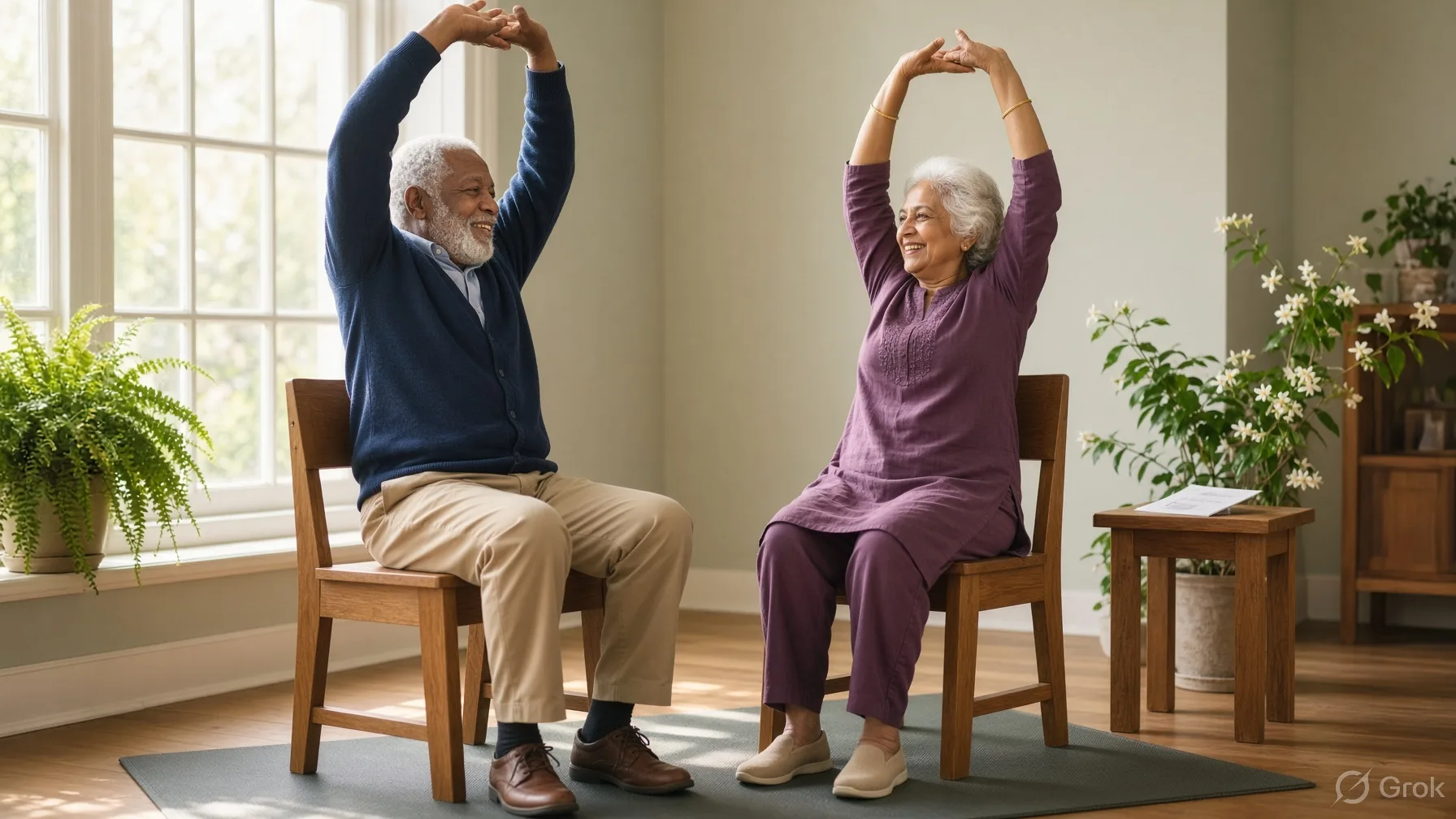
This is a free chair yoga program you can print and follow at home: three levels, four weeks, about 15 minutes a session, three times a week. You start seated, add standing work only when you're ready, and move up a level only when the current one feels easy. No app, no sign-up, no video you have to keep pausing.
Safety matters more with age. The National Center for Complementary and Integrative Health notes that emergency-room visits for yoga injuries are more common in people 65 and older. A US analysis found the 2014 rate for that age group was 57.9 injuries per 100,000 people, compared with 11.9 for adults aged 18 to 44. The answer isn't to avoid yoga. It's to start at the right level and progress slowly, which is exactly what this plan does.
Before you start: a two-minute safety check
Tick every box before your first session.
- A sturdy chair without wheels or arms, with its back against a wall.
- Feet flat on the floor when you sit, knees roughly level with your hips. A folded towel under your feet helps if they don't reach.
- Bare feet or non-slip shoes, never socks on a smooth floor.
- A counter or second chair within reach for any standing work.
- You've asked your doctor if you've had a recent fall, a joint replacement or spine surgery, or if you have osteoporosis, vertigo or heart disease.
Choose your starting level
| Level | Start here if… | What it includes |
|---|---|---|
| 1: Seated | Standing up from a chair is hard, or you've fallen recently | All moves seated |
| 2: Seated plus supported standing | You can stand up from a chair without using your hands, at least once | Seated warm-up, then standing while holding the chair |
| 3: Standing with light support | Level 2 feels easy on most days | Longer holds, one-hand support, slow balance work |
The moves
Breathe through your nose and move slowly. Every move should feel like effort, never like pain.
- Seated breathing. Hands on thighs. Six slow breaths, letting each out-breath be a little longer than the in-breath.
- Seated march. Lift one knee a few inches, lower it, then the other. Thirty seconds.
- Arm raises. Breathe in and lift both arms forward and up as far as comfortable. Breathe out and lower. Six times.
- Seated cat-cow. Hands on knees. Breathe in and gently lift your chest; breathe out and round your upper back slightly. Six times. If you have osteoporosis, skip the rounding and just lift.
- Seated side reach. Reach one arm overhead and lean gently to the other side. Three breaths each side.
- Ankle pumps. Point and flex each foot ten times.
- Sit to stand (Levels 2 and 3). Scoot forward, lean forward, press through your heels to stand, then sit down slowly. Five times.
- Supported heel raises (Levels 2 and 3). Holding the chair back, rise onto the balls of your feet and lower slowly. Ten times.
- Supported tree (Level 3). Holding the chair, rest one heel against the other ankle, toes on the floor. Five breaths each side.
- Seated rest. Sit back, eyes closed if you like, and breathe for one minute.
The four-week plan (print this section)
| Week | Sessions | Level 1 | Level 2 | Level 3 |
|---|---|---|---|---|
| 1 | 3 × 10 min | Moves 1–6, one round | Moves 1–6, plus 3 sit-to-stands | Moves 1–8 |
| 2 | 3 × 12 min | Moves 1–6, one round, longer holds | Moves 1–8 | Moves 1–9 |
| 3 | 3 × 15 min | Moves 1–6, two rounds | Moves 1–8, five sit-to-stands | Moves 1–9, one hand on chair |
| 4 | 3 × 15 min | Two rounds; try one sit-to-stand with hands | Moves 1–9 with two hands on chair | Moves 1–9, two rounds |
When to move up a level
Move up only when all three are true for a full week: you finish every session without needing to stop, you feel steady during standing moves, and you feel fine the next morning. If a new level feels shaky, go back for another week. Moving back isn't failing. It's the plan working.
Choosing the right chair
The chair matters more than most people expect. A wobbly or low chair turns a safe routine into a risky one.
| Look for | Avoid | Why |
|---|---|---|
| Four solid legs, no wheels | Office chairs that roll or swivel | A chair that moves when you stand is a common cause of falls |
| No armrests, or armrests you can work around | Deep armchairs and recliners | Arms block side movements; soft seats make standing harder |
| A firm, flat seat about knee height | Sagging or cushioned seats, bar stools | Your feet should rest flat with knees roughly level with hips |
| A straight back you can hold for balance | Folding chairs that tip easily | You'll hold the chair back for standing moves |
A plain wooden dining chair usually works best. If your feet don't reach the floor, rest them on a thick book or a folded towel.
Adapting the program for common conditions
Most people can follow the plan as written. If one of these applies to you, make the change shown and mention the program to your doctor or physical therapist.
| If you have… | Change this |
|---|---|
| Osteoporosis or low bone density | Skip the rounding part of seated cat-cow; keep twists small; never fold forward with a rounded back |
| A hip replacement | Follow your surgeon's movement precautions exactly; many people are told not to cross their legs or bend the hip past a right angle for a period after surgery |
| Knee arthritis | Keep sit-to-stands partial at first; use your hands; stop short of pain |
| High blood pressure | Keep your head above your heart, breathe normally, and don't hold your breath while straining |
| Numb feet (neuropathy) | Wear supportive non-slip shoes and keep both hands on the chair for standing moves |
| Dizziness or vertigo | Move slowly between positions and stay seated for any move that makes you dizzy |
Five common mistakes
- Holding your breath. Keep breathing through every move; breath-holding raises blood pressure and makes balance harder.
- Moving up a level too soon. A shaky week at a new level is a sign to step back, not push through.
- Practicing in socks. Bare feet or non-slip shoes only.
- Only practicing when you feel great. Short sessions on tired days keep the habit; three short sessions a week beat one long one.
- Ignoring pain. Effort and mild stretching are fine; sharp, pinching or joint pain means stop.
Questions people ask
Is chair yoga really exercise?
Yes, for many older adults it is. Sit-to-stands and heel raises build leg strength, and supported balance work trains the steadiness that helps prevent falls. If you're already fit and active, you'll want to add walking or strength training as well.
How long until I notice a difference?
Many people find everyday movement feels a little easier within a few weeks of practicing three times a week. Balance and strength keep improving over months, which is why falls-prevention research focuses on programs that continue long term.
Can chair yoga help me lose weight?
Only a little on its own. It burns fewer calories than brisk walking. Its real strengths are mobility, balance and confidence. Our honest guide to chair yoga for weight loss after 60 explains what to expect.
Does Medicare pay for chair yoga classes?
Original Medicare doesn't cover yoga classes, but many Medicare Advantage plans include a fitness benefit that can cover classes at participating locations or online. Our guide to SilverSneakers and plan benefits shows how to check.
Can I do this with a family member?
Yes, and it's often more fun. Sit side by side, go at the slower person's pace, and keep both chairs against a wall. If you care for someone with dementia, see our guide to chair yoga together.
Where to go next
- Ready for more balance work? Try our 12-minute chair balance sequence.
- Prefer a daily challenge? The free 28-day chair yoga plan gives you one short session a day.
- Over 80, or starting after illness? Use the gentlest safe sequence.
- Wondering if Medicare covers classes? Read about SilverSneakers and plan benefits.
- Helping a parent start? Our guide to yoga for seniors covers every mobility level.
Sources
- CDC: Older Adult Fall Prevention, Facts and Stats — about 1 in 4 adults 65+ fall each year
- Sherrington C et al. Exercise for preventing falls in older people living in the community. Cochrane Database of Systematic Reviews, 2019 — exercise reduces the rate of falls by about 23%
- NCCIH: Yoga, Effectiveness and Safety — older adults and yoga-related injuries
- Swain TA, McGwin G. Yoga-related injuries in the United States from 2001 to 2014. Orthopaedic Journal of Sports Medicine, 2016 — injury rate 57.9 per 100,000 in adults 65+ in 2014