Page 11 of the book, in Arogya
Chair Yoga for Balance After 65: A 12-Minute Sequence
A safe, seated-and-standing chair yoga sequence for older adults that works on balance, leg strength and confidence, with easier and harder options for every step.

This 12-minute chair yoga sequence works on the three things that keep you steady on your feet: leg strength, ankle control and confident weight shifting. You start seated, move to standing with the chair as support, and finish seated again. Do it three times a week and increase slowly.
Balance is worth the time. The CDC reports that about 14 million adults aged 65 and older, roughly one in four, fall each year in the US, and about 37% of those who fall are injured badly enough to need medical care or limit their activity for at least a day. Falls are the leading cause of injury in this age group. The good news is that exercise helps: a 2019 Cochrane review led by Catherine Sherrington found that exercise programs cut the rate of falls in older people living at home by about 23%.
Set up safely first
A good setup takes two minutes and removes most of the risk. Check each item before your first session.
- A sturdy chair without wheels or arms, set on a non-slip surface. Push its back against a wall so it can't slide.
- A second support within reach, such as a kitchen counter, for the standing part.
- Bare feet or non-slip shoes. Never socks on a smooth floor.
- Clear space around you, free of rugs, cords and pets.
- Water nearby, and a phone in your pocket if you're alone.
The 12-minute sequence
Breathe slowly through your nose throughout. Move within a comfortable range, and never hold your breath to push further.
- Seated breathing (0:00–1:00). Sit near the front of the chair, feet flat and hip-width apart. Rest hands on your thighs. Take six slow breaths, letting the exhale be a little longer than the inhale.
- Seated march (1:00–2:00). Lift one knee a few inches, lower it, then the other. Keep your back tall and hold the seat edges if you like.
- Ankle circles and toe lifts (2:00–3:00). Lift one foot slightly and circle the ankle five times each way. Then, with both feet down, lift your toes and lower them ten times.
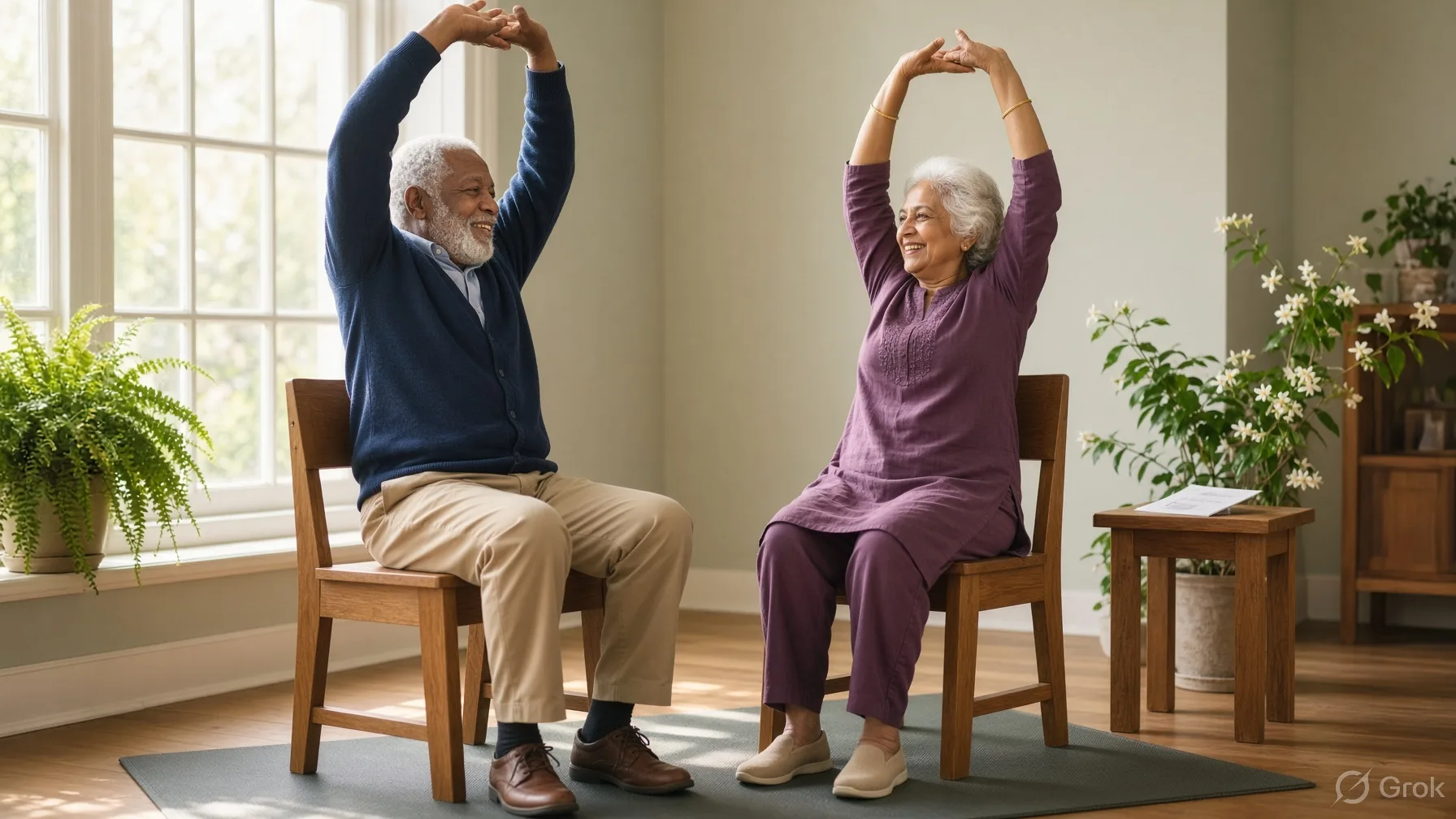
- Seated side stretch (3:00–4:00). Reach your right arm overhead and lean gently to the left, holding the seat with your left hand. Three breaths, then switch.
- Seated twist (4:00–5:00). Place your right hand on your left knee and your left hand on the chair behind you. Turn gently from the ribs, not the neck. Three breaths each side.
- Sit to stand (5:00–6:30). Scoot forward, feet under knees. Lean forward, press through your heels and stand up, then sit down slowly with control. Five to eight times, using your hands only if needed.
- Standing heel raises (6:30–7:30). Stand behind the chair holding the backrest with both hands. Rise onto the balls of your feet, then lower slowly. Ten times.
- Weight shifts (7:30–8:30). Still holding the chair, shift your weight slowly to your right foot until the left foot feels light, then to the left. Ten shifts.
- Supported tree pose (8:30–10:00). Hold the chair with one or both hands. Rest your right heel against your left ankle, toes on the floor. Stand tall for five breaths, then switch. This is the heart of the balance work.
- Chair warrior (10:00–11:00). Sit sideways on the chair with your right thigh on the seat. Extend your left leg back, toes on the floor, and reach both arms forward. Three breaths, then switch.
- Seated rest (11:00–12:00). Sit back, close your eyes if comfortable, and breathe slowly. Notice your feet on the floor.
Make it easier or harder
| Step | Easier | Harder |
|---|---|---|
| Sit to stand | Use your hands and a firm cushion on the seat | Cross your arms over your chest |
| Heel raises | Rise only a little | Hold the top for two breaths |
| Weight shifts | Keep both feet down, shift slightly | Lift the light foot an inch |
| Tree pose | Two hands on the chair, heel at the ankle | One fingertip on the chair |
| Chair warrior | Keep the back knee bent | Hold for five breaths |
Move up one level only after two weeks at the current one feels easy. Progress in balance comes from regular practice, not from pushing on any single day.
How often, and for how long
Aim for three sessions a week. Research on exercise for falls prevention suggests that programs work best when they continue over months, so treat this as a long-term habit rather than a short course. On days you feel strong, add a short walk. On tired days, do only the seated half.
If you're helping a parent or partner with this, sessions together are safer and more fun. Our upcoming piece on yoga for caregivers has ideas for looking after yourself too.
Check your balance at home
Doctors often use a simple four-stage balance test, part of the CDC's STEADI fall-prevention toolkit. Try it next to a counter, with someone nearby if possible. Hold each position for 10 seconds without holding on:
- Feet side by side.
- One foot slightly in front of the other, the instep touching the big toe of the back foot.
- One foot directly in front of the other, heel to toe.
- Standing on one foot.
If you can't hold the heel-to-toe position for 10 seconds, your risk of falling may be higher. Share that with your doctor and use this sequence regularly. Retest every month to see progress.
Make your home safer too
Exercise works best alongside a safer home:
- Good lighting on stairs and a night-light between bedroom and bathroom.
- Remove loose rugs and clutter from walkways.
- Grab bars in the shower and beside the toilet.
- Handrails on both sides of the stairs.
- A yearly eye check and a review of your medicines with your doctor or pharmacist, since some medicines cause dizziness.
More questions
How long before my balance improves?
Many people feel steadier within a few weeks of practicing three times a week. Programs studied for fall prevention usually run for months, so keep going even when it feels easy.
I use a walker. Can I still do this?
Do the seated moves, and ask a physical therapist which standing moves are safe for you. They can also check that your walker is the right height.
Should I do this every day?
Three days a week is a good goal. Daily practice is fine if you feel good, especially the seated moves.
Where to go next
Once this feels comfortable, you can add breath practice with our guide to calming breathing techniques, or build toward floor work with the beginner home yoga plan, using its easier options. For a gentle four-week progression, use our free printable chair yoga program.
Sources
- CDC: Older Adult Fall Prevention, Facts and Stats — falls among adults 65 and older
- National Safety Council Injury Facts: Older Adult Falls — deaths and emergency visits
- Sherrington C et al. Exercise for preventing falls in older people living in the community. Cochrane Database of Systematic Reviews, 2019 — exercise reduces the rate of falls